

Accounting Without Accountants (Part 3): Redesigning the Finance Function with Agentic AI
/
For most companies, the accounting function is a cost center that business strategy works around rather than through. Agentic AI changes that equation. The opportunity is not cheaper bookkeeping; it is a new strategic capability: a finance function that informs, tests and accelerates the decisions that create enterprise value. Capturing it starts with a clear diagnosis and requires four deliberate moves.
1. The Starting Point: An Accounting Function Built for Compliance, Not for Strategy
Not designed to enable business strategy. In most companies, the accounting function and its systems were never designed as an enabler of business strategy. They were built to satisfy external stakeholders: tax authorities, auditors and lenders. Investment decisions reflect that origin. Accounting technology is still evaluated through a commodity lens, judged by how much administrative overhead it removes or how many days it takes off the month-end close, rather than by the strategic capabilities it creates.
Manual workflows and today's accounting technology lock in that design. Transactions are keyed by hand, reconciled after the fact and reported weeks after month-end. Charts of accounts mirror tax and audit requirements rather than the company's economic model. Any analysis beyond the standard reports depends on spreadsheet workarounds that are slow to build and hard to keep accurate. The result is a structural blind spot: leadership steers by outdated, aggregated numbers, and the signals that matter most to business strategy, such as margin erosion by product line, rising customer acquisition costs or an approaching cash constraint, surface only after the window to act has narrowed.
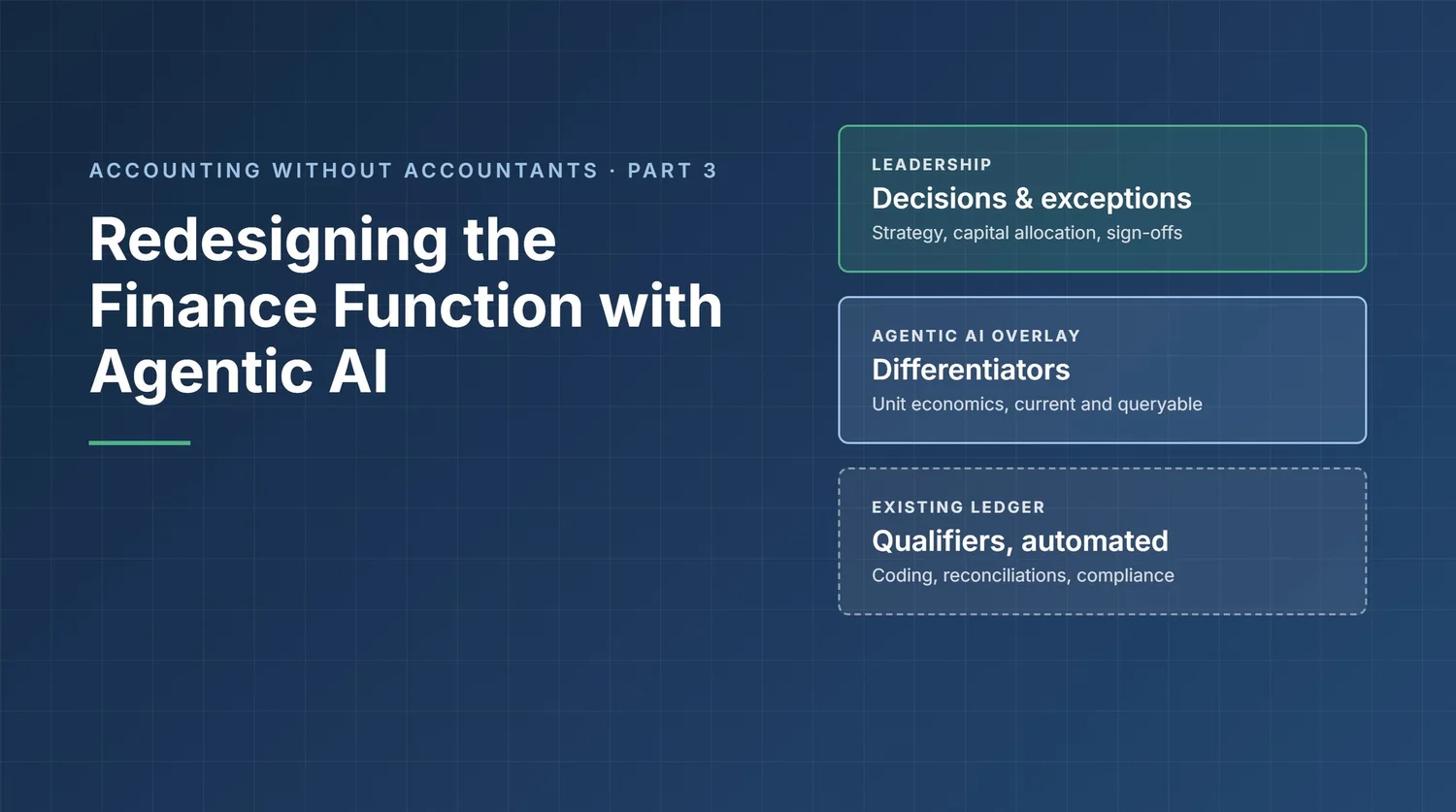
Keep the core systems; add an agentic AI overlay. Building this capability does not require replacing the accounting system. The existing ledger and software remain the system of record, while an overlay of agentic AI takes over the manual workflows, keeps the books continuously current and organizes the data around how the company actually creates value. The overlay turns the accounting function from a compliance utility into an enabler of business strategy.
Start where the value is: management decision making. The first and largest payoff is decision support: accurate, up-to-date and flexible information that leadership can interrogate by customer, product, channel or project as strategic questions arise. The measure of success is therefore not cost reduction or software adoption, but decision quality: how early cash pressure becomes visible, how precisely capital is allocated, and how quickly leadership can act on what the numbers show.
2. Establish the Baseline: Remediate the Historical Record
No capability can be built on an unreliable foundation. Years of manual bookkeeping leave most ledgers with accumulated inconsistencies, and those inconsistencies limit what any automation can deliver.
Diagnose the legacy books. Historical ledgers typically carry silent misclassifications, unresolved reconciliation items and catch-all clearing accounts (such as "Ask My Accountant") that obscure the true economics of the business.
Run a structured cleanup. Agentic workflows scan the historical record, isolate structural gaps and request the missing source documents or management decisions needed to close them.
Lock in a clean baseline. Reconciled, structurally sound books are a non-negotiable prerequisite. Automated rules amplify whatever data they run on; the baseline must be correct before the finance organization and its processes change.
3. Design the Architecture: Separate "Qualifiers" from "Differentiators"
The central design choice is to stop treating every accounting process as equally important. Finance functions should distinguish between two categories of capability: qualifiers, which a company must execute to stay in business, and differentiators, which create competitive advantage. Qualifiers are the legacy compliance function, now automated. Differentiators are the strategic capability the overlay makes possible.
| Qualifiers | Differentiators | |
|---|---|---|
| Purpose | Stay in business: compliance and basic hygiene | Create competitive advantage |
| Examples | Transaction coding, tax compliance, bank reconciliations, regulatory reporting | Margins by customer, product line, sales channel and project, kept current |
| Design principle | Automate and minimize cost | Build around the company's economic model |
| Who executes | Deterministic rules | Rules and AI agents, with management setting the dimensions |
Qualifiers: Automate and Minimize Cost
Transaction coding, tax compliance, bank reconciliations and regulatory reporting are essential, but they do not create competitive advantage: executing them well does not win market share, while executing them poorly invites penalties, audit findings or covenant breaches. Clearly defined, deterministic rules run these processes automatically, so they no longer absorb senior management attention.
Differentiators: Build Around the Company's Economic Model
Strategic value is created when the chart of accounts and the data dimensions are designed around how the company makes money rather than around compliance templates. That means tracking unit economics, such as margins by customer, product line, sales channel and project, and keeping them current as transactions post. Consider a consumer brand selling through Amazon and Walmart: marketplace fees, returns and freight are often pooled in generic accounts, which obscures the true profitability of each channel. Dimensions built around the channels make channel economics visible and turn the general ledger into an input to pricing, cost management and resource allocation.
Clear Decision Rights: Rules, AI and People
Deterministic rules execute recurring coding and reconciliations. AI agents read source documents, classify new or unusual items and prepare exceptions with their supporting evidence. People retain the judgment calls: estimates and accruals, revenue recognition, ownership of controls, and the relationships with auditors and lenders. No AI-proposed entry outside the established rules is posted without human approval.
Management by Exception
Routine transactions that meet established rules are processed automatically, with no management review. Only exceptions reach leadership: strategic anomalies, cash-flow risks and policy breaches, each escalated with full supporting documentation. Leadership attention is spent where judgment adds value, not on approving routine activity.
4. Redesign the Accounting and Finance Organization and Its Processes
With the architecture in place, the accounting and finance department itself changes: its processes, its structure and its control environment. Mechanical execution moves to rules and AI agents; decision rights stay with management.
| Dimension | Traditional Model | Redesigned Model |
|---|---|---|
| Processes | Periodic batches; documents keyed and reconciled after month-end | Continuous flow; rules execute as transactions arrive; the close confirms rather than reconstructs |
| Organization | Transaction-processing layer of bookkeepers and staff accountants | Smaller, more senior team maintaining rules, reviewing exceptions and producing analysis |
| CFO role | Supervising data entry | Owning the finance architecture, exception governance and high-stakes sign-offs |
| Controls | Depend on individual diligence, often one person | Embedded in the process and applied to every transaction |
Processes: from periodic batches to continuous flow. In the traditional model, the core processes (procure-to-pay, order-to-cash and record-to-report) run in batches, with documents collected, keyed and reconciled in the weeks after month-end. In the redesigned model, bills, receipts and bank feeds flow into a single, AI-monitored intake pipeline, and rules execute as transactions arrive. The books remain current throughout the month, and the formal close becomes a confirmation step rather than a weeks-long reconstruction.
Organization: a smaller, more senior team. The transaction-processing layer, the bookkeeping and staff-accounting roles whose hours were consumed by data entry, coding and reconciliations, shrinks substantially, and in smaller companies can largely disappear. Leadership should plan for this explicitly rather than let it happen by attrition. The roles that remain are fewer but more skilled: maintaining the rules, reviewing exceptions, and turning current data into analysis that management can act on. The CFO, whether in-house or fractional, moves from supervising data entry to owning the finance architecture, the governance of exceptions and the high-stakes sign-offs. The lower personnel cost is real, but it is a by-product; the strategic gain is a finance team that spends its time on decisions rather than on data.
Controls: stronger than the manual model they replace. Manual processes depend on individual diligence, and in small teams often on a single person who enters, approves and reconciles the same transactions. The agentic layer embeds controls in the process itself: it enforces segregation of duties, validates every amount against its source document, flags changes to vendor bank details before payment, and attaches a complete audit trail to every general ledger entry. Controls no longer depend on who is on duty; they are applied to every transaction, every time.
5. Capture the Value: Decision Intelligence and Strategic Steering
The ultimate return on this capability is the elimination of friction between financial data and strategic decisions.
Retire fragile spreadsheets. Spreadsheet-error research has repeatedly found errors in most of the operational spreadsheets it examined. Self-updating management dashboards, built directly from the differentiated ledger, replace them.
Direct access to insight. Leadership no longer depends on report specialists or software upgrades to answer strategic questions. Executives can query financial data in plain language to assess cash runway, customer profitability and cost structure on demand.
Scenario testing before commitment. With current financial intelligence available, leadership can test pricing changes, market entry, refinancing options and operational restructuring against live company data before making irreversible commitments.
Conclusion: Finance as a Strategic Capability
Agentic AI is the enabler that makes this transformation possible. Earlier generations of accounting software digitized the compliance log; they could not read documents, classify the unusual, prepare exceptions or answer a strategic question in plain language. Agentic AI can, and it does so on top of the accounting system the company already runs. The path is clear: clean the historical record, automate the qualifiers, build the differentiators around the company's economic model, and run a smaller, more senior finance team that manages by exception. The payoff is a durable strategic capability: earlier visibility into cash, sharper capital allocation and the agility to act on what the numbers show.
This is not a future scenario. As the earlier articles in this series show, the capability is available today. Because it overlays existing systems rather than replacing them, it is fast to implement, and because it works in plain language, anyone in the organization can use it, from the CEO to the operating managers, without waiting for a report specialist. There is no onboarding and no new software to learn: users simply ask questions and give instructions, as they would to a colleague. Nor does it require giving up control. Rules are set by management, every exception is escalated with its evidence, and no entry outside the established rules is posted without human approval. Control becomes stronger, not weaker.
The uncomfortable implication is that a traditional bookkeeping and staff-accounting layer is no longer a necessary cost of doing business; it is a choice. Companies that keep paying people to key, code and reconcile transactions are not buying accuracy or control, because the agentic model delivers more of both. They are buying delay, and making strategic decisions on numbers their competitors saw weeks earlier.
For founders, CEOs and finance leaders: is your accounting team an asset that informs strategy, or a habit no one has questioned?
About This Series: Agentic AI and the Automated Ledger
Article 1: Accounting Without Accountants (Part 1) – How Agentic AI Took the Ledger
Showcased the practical architecture of an operational Agentic AI system and its core advantages over traditional, manual accounting workflows.Article 2: Accounting Without Accountants (Part 2): Why Routine Accounting Jobs Will Quickly Fade
Made the strategic case for transformation, showing how Agentic AI enables accounting to fulfill its higher mission of real-time management decision support.Article 3 (This Article): Accounting Without Accountants (Part 3): Redesigning the Finance Function with Agentic AI
Sets out how to redesign the finance function around Agentic AI: the baseline, the architecture, the organization and its processes, and the value it creates.
This article is for general information and is not legal, tax, or financial advice.