Is AI a Bubble? Six Arguments, Examined
/
The six main arguments that AI is a bubble, from the revenue gap to circular financing and GPU depreciation, and why each one falls short on the evidence.
Read MoreCollection of articles aligned with our vision and services.
The six main arguments that AI is a bubble, from the revenue gap to circular financing and GPU depreciation, and why each one falls short on the evidence.
Read MoreDiscover why NVIDIA is set to lead the AI revolution, not follow Cisco's trajectory. With a seamless ecosystem of hardware, software, and platforms, NVIDIA locks in clients and developers while driving an AI transformation with no limits in sight.
Read MoreDiscover how ASICs and NVIDIA GPUs compare in AI performance, cost, energy efficiency, and ecosystem support. Explore their roles in shaping the future of Artificial General Intelligence and NVIDIA's sustained dominance in AI.
Read More
SaaS Threatened by the AI Cloud
SaaS providers must adapt quickly, finding new ways to add value in a landscape about to be dominated by AI-driven, customizable platforms.
The landscape of cloud services is undergoing a seismic shift. Traditional Software as a Service (SaaS) offerings, once the gold standard for ease of use and accessibility, are now facing unprecedented challenges from the rapid rise of AI-based Platform as a Service (PaaS). Unlike SaaS, which provides standardized software solutions, AI-based PaaS offers a vertically integrated stack—complete with AI tools, specialized hardware, and end-to-end development environments—that empowers users to create customized, intelligent applications with minimal coding effort. This evolution threatens the viability of SaaS as AI tools become increasingly accessible to end-users through no-code and low-code interfaces, enabling businesses to innovate independently and develop tailored solutions more efficiently than ever before.
In this article, we will explore how the rise of AI-based PaaS is not just reshaping but redefining the competitive landscape. We will analyze the implications for traditional SaaS and PaaS providers, examine the growing influence of players like NVIDIA, and understand why the future of cloud computing may belong to those who control both hardware and AI capabilities. Whether you are a SaaS provider, an enterprise decision-maker, or simply interested in the future of technology, this analysis will provide critical insights into the opportunities and existential threats that lie ahead.
Software as a Service (SaaS) provides users with access to applications via the internet. These applications are managed by SaaS providers, eliminating the need for users to maintain their own on-site infrastructure. SaaS is well-known for its ease of use and subscription-based pricing model. Popular examples include Salesforce, Zoom, and Slack, which offer ready-made software designed for specific user needs.
Platform as a Service (PaaS) provides a platform for developers to create and deploy custom applications. Unlike SaaS, which offers pre-built software, PaaS delivers the tools, runtime environments, and infrastructure needed for software development. Examples include Microsoft Azure and Amazon AWS. PaaS allows businesses greater flexibility to build software tailored to their specific requirements, though it demands more technical expertise than SaaS.
AI-based PaaS represents the next level of integration by incorporating AI capabilities across the entire technology stack, enabling seamless optimization and improved performance. This vertical integration extends from hardware components to advanced software tools. The following table outlines different levels of vertical integration and coverage by major players in the AI-based PaaS space:
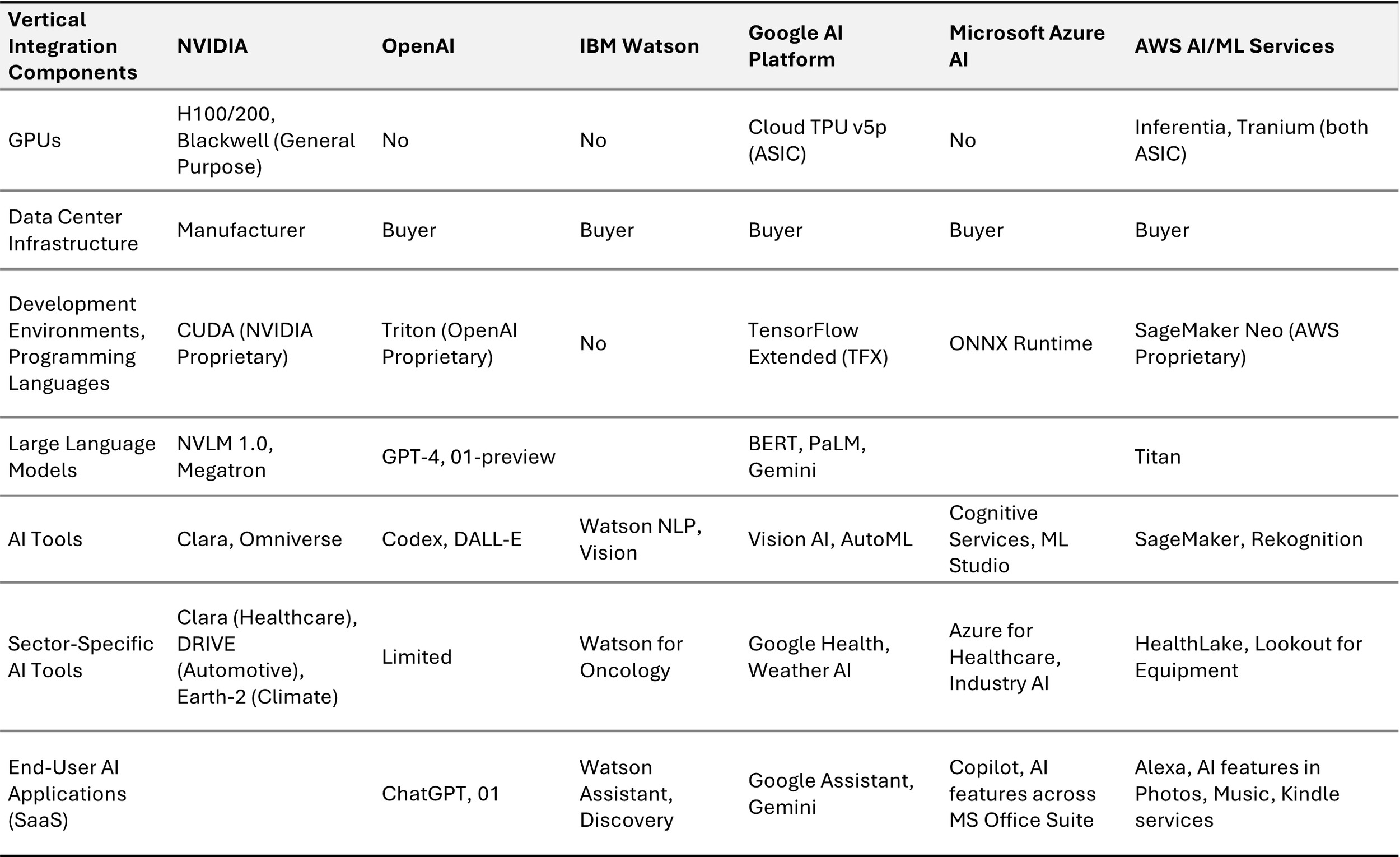
AI-based PaaS reduces reliance on external providers, leading to better cost efficiency by minimizing third-party expenses, improved control over key processes, and enhanced security by reducing the number of external access points. This level of vertical integration supports optimized performance, reduced third-party costs, and minimized risk, creating a competitive moat for companies.
To stay competitive, traditional SaaS providers are embedding AI features into their existing services. Examples of these efforts include:
Salesforce Einstein: Automates customer interactions, offering predictive sales analytics.
Microsoft Office Copilot: Assists users by generating content, summarizing information, and enhancing productivity.
Adobe Sensei: Provides AI-powered automation for editing tasks, content recommendations, and marketing optimization.
ServiceNow AI: Incorporates AI capabilities to improve workflow automation and create virtual agents.
Zoom Virtual Assistant: Adds value by summarizing meetings, providing real-time transcriptions, and automating scheduling.
While these AI enhancements by SaaS providers are notable, their reliance on PaaS providers for infrastructure makes their business model increasingly fragile, limiting their control over the entire stack. This dependence on external infrastructure restricts SaaS providers from integrating AI seamlessly and limits their ability to innovate beyond pre-built tools and interfaces.
AI-based PaaS integrates everything from GPUs to sector-specific AI tools, delivering fully optimized, high-performance solutions without relying on third-party vendors. This comprehensive integration allows for a unified stack that includes specialized hardware, custom AI tools, and advanced software environments, providing superior performance and flexibility that traditional SaaS offerings cannot match.
SaaS offers standardized software solutions that are easy to deploy but inherently limited in customization and scalability. In contrast, AI-based PaaS empowers end-users to create highly tailored solutions with minimal IT development through no-code or low-code capabilities. As more businesses opt for customized, AI-driven applications that better fit their specific needs, SaaS providers face a major competitive threat, both in terms of pricing and capabilities. This shift threatens the long-term viability of traditional SaaS models, as users increasingly favor more adaptable and cost-effective AI-based solutions.
In general, traditional PaaS providers (e.g., Amazon AWS, Microsoft Azure) are incorporating AI capabilities to keep up with market demands. However, while some have developed their own stack components, they largely rely on NVIDIA for critical elements like training GPUs and AI development tools. NVIDIA has significant advantages due to their deep vertical integration across the AI stack. As outlined in the table in Section 2, NVIDIA not only manufactures advanced GPUs like H100/200 and Blackwell, but also controls proprietary development environments (CUDA), sector-specific AI tools (such as Clara for healthcare and DRIVE for automotive), and large language models (NVLM 1.0, Megatron). This vertical integration allows NVIDIA to optimize performance across all components, reduce dependency on third-party suppliers, and offer comprehensive, highly efficient AI solutions. Traditional PaaS providers that lack this level of integration are at a disadvantage, struggling to match the seamless control over hardware, software, and development tools that NVIDIA can deliver.
AI-based cloud solutions offer both significant benefits and potential challenges for end users. By integrating AI capabilities throughout the technology stack, these solutions provide enhanced customization and performance optimization, while also introducing complexities related to cost, learning curve, and vendor dependency. The following list outlines these pros and cons, helping end users make informed decisions about adopting AI-based cloud technology.
Customization and Flexibility: AI-based PaaS allows for tailored solutions that meet specific industry needs.
Efficiency Gains: The vertically integrated approach reduces development time and enhances overall application performance.
Seamless AI Integration: AI-based PaaS provides a unified technology stack, ensuring smoother integration of AI tools.
Reduced Third-Party Dependency: By reducing reliance on external vendors, businesses can enhance security and reduce risk.
Learning Curve: Although reduced, some retraining is required for teams to transition to AI-based systems.
Cost of Adoption: Transitioning to AI-based PaaS requires initial investments, though reduced dependence on expensive hardware like GPUs can mitigate costs over time.
Vendor Lock-In: A high level of dependence on a single provider's ecosystem may limit future flexibility and innovation opportunities.
User-developed solutions built on AI-based PaaS are already replacing traditional SaaS offerings. By leveraging AI platforms, businesses can create highly customized and efficient applications tailored to their needs, outperforming the standardized capabilities of SaaS. This shift provides organizations with greater control over data, optimized costs, and more specialized functionalities, ultimately empowering them to develop solutions that are precisely aligned with their strategic goals.
Healthcare (NVIDIA Clara): Clara has been used by healthcare providers to improve diagnostics and treatment planning, replacing traditional SaaS-based medical imaging solutions.
Automotive (NVIDIA DRIVE): DRIVE supports autonomous vehicle development, providing an integrated AI platform for sensor data processing and navigation.
Retail (Google AI Platform): Retailers have transitioned from using generic SaaS-based analytics to customized AI-driven insights using Google AI.
Financial Services (Azure AI): A financial firm replaced its traditional SaaS CRM with an in-house AI-driven platform using Azure AI, gaining control over data, reducing costs, and allowing non-technical users to interact through natural language commands.
The future for traditional SaaS providers appears increasingly uncertain as AI-based PaaS continues to gain traction. To avoid becoming obsolete, SaaS providers must evolve to remain relevant in an AI-driven landscape where customizability, efficiency, and direct control over the stack are paramount. The following strategies outline potential ways for SaaS providers to survive, delay market contraction, and maintain their presence in an environment where user-developed, AI-powered applications are setting a new standard:
Integrate AI Capabilities into Existing Services: Embedding AI into core offerings can improve automation, personalization, and analytics. This trend is already happening across major SaaS providers, with AI becoming an integral feature to stay competitive (see Section 4). However, relying solely on these enhancements is likely a short-term solution rather than a long-term guarantee of survival.
Partner with AI-Based PaaS Providers: Forming strategic partnerships with AI-based PaaS providers can grant SaaS companies access to cutting-edge AI technology, allowing them to offer SaaS solutions enhanced by AI that combine ease of use with sophisticated AI capabilities. For example, SaaS providers like HubSpot and Dropbox have leveraged external AI-based PaaS to integrate advanced analytics and automation into their platforms, enhancing their features without the need to develop their own AI infrastructure. The largest threat here once again is users developing their own customized solutions, now empowered by no-code or low code AI capabilities.
Enable In-House AI Development for Enterprises: SaaS providers can offer the necessary tools and consulting to help enterprises develop in-house AI-based solutions, thus transitioning away from generic SaaS. This shift changes their business model from subscription-based revenues to one-off IT development and AI consulting engagements, which could alter their revenue stability and growth dynamics.
Develop Niche Applications: By focusing on niche markets where vertical integration is less critical, SaaS providers can target specialized functionalities and industries to remain competitive. However, this strategy is likely to reduce their addressable market and lead to downsizing, as they will focus on a narrower audience compared to the broader reach of traditional SaaS offerings.
Act as an AI Bridge for Enterprises: Assist businesses in the early stages of AI adoption by offering services that facilitate a smoother transition to AI-based solutions, such as educational resources and managed AI services. This shift also represents a change in their business model from subscription-based revenues to mostly one-off services, which could impact revenue predictability and growth potential.
Failure to adapt could lead to a rapid and significant loss of market share as AI-based PaaS continues to evolve at a breakneck pace. This transformation underlines the urgency for traditional SaaS providers to innovate, differentiate, and adapt quickly. The growing empowerment of users to develop their own solutions with no-code or low-code AI tools is accelerating this threat. SaaS providers must explore specialized niches or take on a pivotal role in facilitating early AI adoption for clients. This will require a shift from the traditional subscription-based model to a focus on one-off services and consulting engagements, reducing their addressable market and potentially downsizing operations.
The AI revolution differs fundamentally from the internet revolution. During the internet boom, infrastructure players missed out on capturing significant value, which was largely claimed by SaaS and content providers. In contrast, the AI revolution places infrastructure players like NVIDIA in a dominant position. With their vertically integrated stacks, they stand to capture much of the value that traditionally went to application developers.
AI infrastructure is highly advanced, involving specialized data centers and algorithms that can autonomously write software, making traditional development approaches less relevant. By controlling both hardware and software, AI-based PaaS players are positioned to dominate the next phase of technological evolution. In this AI revolution, traditional SaaS providers face an existential threat, as the shift to vertically integrated, AI-driven platforms fundamentally challenges their core business models and value propositions.
The evolution from traditional SaaS to AI-based PaaS is not just an incremental change but a fundamental shift in the technology landscape. AI-based PaaS, with its vertically integrated stacks and powerful customization capabilities, is rapidly transforming industries, giving businesses the ability to create tailor-made solutions that are more efficient, cost-effective, and innovative than standardized SaaS offerings.
Traditional SaaS providers face an existential threat as users increasingly embrace AI-based PaaS solutions, empowered by no-code and low-code tools that democratize software development. This shift threatens the long-term viability of the SaaS model, as users and enterprises opt for more adaptive and intelligent technologies. The future of SaaS lies in its ability to pivot—whether by embedding AI, forming strategic partnerships with PaaS providers, or developing niche, specialized solutions.
The key to survival for SaaS providers is to adapt quickly, finding new ways to add value in a landscape about to be dominated by AI-driven, customizable platforms. Those that succeed will be the ones who innovate aggressively, develop unique value propositions, and embrace the inevitability of AI integration across every layer of technology. For those that fail to adapt, the outcome is clear: obsolescence in an increasingly competitive and rapidly evolving tech ecosystem.
If you need to better understand the potential role of AI in Business Strategy, Operations or Finance or would like to discuss the benefits of a CFO on Fractional basis contact us
CFO_3.10 To read related articles go to our Blog
AI startups face platform risk when relying on large language models as core technology. Key strategies help reduce the impact of platform dependency, maintain differentiation, and foster adaptability, ensuring that AI startups can thrive even in the face of evolving platform dynamics.
Read MoreLearn how small and medium-sized enterprises (SMEs) can leverage AI capabilities to enhance profitability, streamline operations, and drive growth. This guide provides a practical AI adoption framework, covering key strategies, use cases, and tips for overcoming common barriers.
Read MoreDiscover how artificial intelligence is revolutionizing software startups. From AI's impact on code generation and bug detection to long-term industry disruptions and job market upheavals, learn about the profound implications for the future of software development.
Read MoreDetailed framework for developing an AI strategy aligned with the business strategy. Learn how to define AI vision, assess capabilities, and implement initiatives to drive innovation, enhance efficiency, and achieve sustainable growth in an AI-driven world.
Read MoreArtificial Intelligence (AI) is becoming a powerful enabler in the financial sector due to several key characteristics and capabilities that align well with the industry's needs. AI is transforming operations, enhancing customer experiences, and providing institutions with a competitive edge in a data-driven world.
Read MoreWhat a fractional CFO does for AI and tech companies, what changes with compute-driven costs and usage pricing, and when founders need one.
Read MoreFractional CFOs and COOs. Investor Pitches. Fundraising Strategies. Business and Operational Strategy development.
Let’s discuss how our services can meet your needs..
We offer two options.
Fill out our Contact Form.
Schedule a Call in our Calendar below.
Use this form only to inquire about contracting our services. Do not use it for job inquiries, partnership proposals, or similar requests. Non-compliant emails will be reported as spam.
ABOUT US
Experience working with Fortune 100 companies through early stage startups. Capable of "hitting the ground running" and rapidly achieving meaningful results by leveraging a breadth of strategy, operational, financial and technical skills coupled with a flexible, outsourced workforce, when needed.