

Why NVIDIA Won’t Be the Next Cisco: Dominating the AI Revolution
/Introduction
NVIDIA isn’t just leading the AI revolution—it’s redefining what technological dominance looks like. While Cisco’s stagnation in the 2000s highlighted the risks of fragmented infrastructure, NVIDIA’s strategy breaks the mold entirely. By building a seamless ecosystem of hardware, software, and platforms, NVIDIA powers cutting-edge innovation and positions itself as the cornerstone of an AI-driven future. Unlike the Internet revolution, which plateaued once infrastructure was established, the AI revolution has no defined limits—and NVIDIA is primed to lead this limitless transformation.
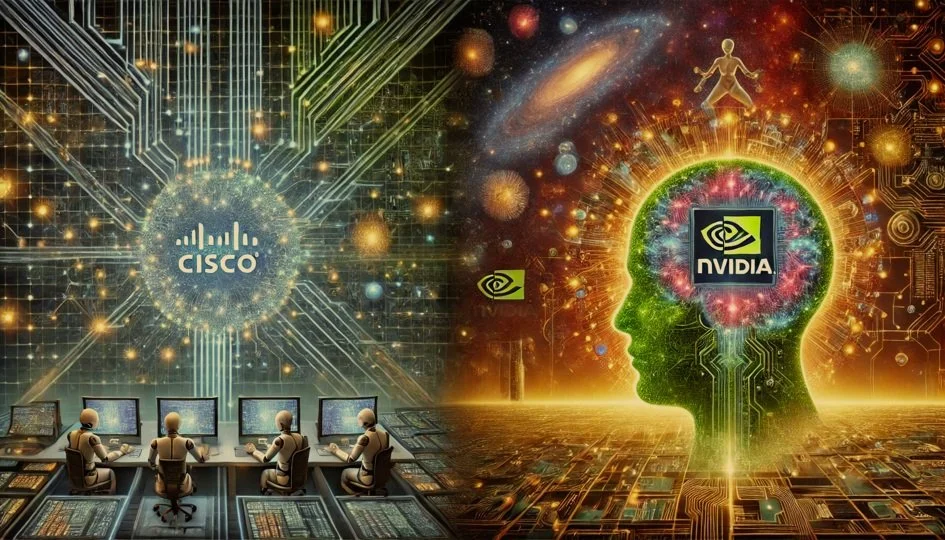
NVIDIA & Cisco Comparison
In depth analysis on why NVIDIA won’t become the next Cisco
GPUs: NVIDIA’s Current Identity
NVIDIA is widely recognized for its GPUs, synonymous with high-performance gaming and AI capabilities. The GeForce RTX series leads in gaming, while enterprise GPUs power advancements in AI, cloud computing, and autonomous systems. This reputation solidifies NVIDIA as a leader in accelerated computing.
NVIDIA’s core revenue streams include GPUs like the A100, H100, and upcoming Blackwell series, driving AI training and inference across industries. Its annual GPU refresh cycle minimizes delays in adoption, maintains technological leadership, and prevents competitors like AMD from gaining ground. This strategy keeps application developers and enterprises invested in NVIDIA’s ecosystem, ensuring sustained dominance.
From Connectivity to Intelligence: Why AI Outshines the Internet Revolution
The Internet revolution connected the world through communication and data sharing, but its transformative phase slowed once global infrastructure was established. In contrast, the AI revolution fundamentally alters human activity, with no clear endpoint. Unlike heuristic-based routers, NVIDIA’s AI-driven platforms go beyond fixed rules, enabling machine learning models to evolve autonomously, optimize algorithms, and make independent decisions. Examples include autonomous vehicles refining navigation or predictive maintenance systems adapting to new data patterns.
Generative AI, likened to a smart high schooler, excels in text generation and pattern recognition. On the horizon lies Artificial General Intelligence (AGI), rivaling human cognition, and Superintelligence, surpassing human reasoning and creativity. NVIDIA’s GPUs power this evolution, enabling breakthroughs like autonomous experiment design and innovative technologies.
The AI revolution has sparked a global "arms race" as nations and corporations compete to achieve AGI and Superintelligence. The stakes are massive: AGI promises human-like abilities, while Superintelligence could transform fields like medicine and defense. Falling behind carries existential risks, from losing competitive advantages to obsolescence. NVIDIA, at the core of this race, powers critical AI models, ensuring its role in reshaping society. Where the Internet connected the world, AI redefines it—ushering in an era where intelligence, not connectivity, drives progress.
Learning from Cisco: Why NVIDIA Won’t Plateau
The public’s perception of NVIDIA as a GPU provider often leads to comparisons with Cisco during the Internet boom. Both dominated high-margin, fast-growing markets, but their paths diverge sharply:
NVIDIA is at the Core of the AI Revolution
The Internet connected the world through communication and data exchange, but its transformative phase ended once infrastructure like routers and fiber optics was in place. By contrast, the AI revolution is fundamentally reshaping society with continuously advancing cognitive capabilities, progressing toward AGI and Superintelligence with no clear endpoint. At the core of this race, NVIDIA powers critical AI models, cementing its role in redefining the future. While the Internet revolution linked the world, the AI revolution is poised to reshape it—ushering in an era where intelligence, not connectivity, drives progress.
NVIDIA’s Ecosystem vs. Cisco’s Infrastructure
NVIDIA controls multiple layers of the AI stack, creating nearly insurmountable barriers to entry. Cisco’s peak dominance in networking lacked synergy across efforts like WebEx and UCS, leaving it vulnerable. Agile competitors like AWS capitalized on developer-friendly platforms, while NVIDIA’s integrated ecosystem—combining hardware, software, and developer tools—ensures resilience and sustainable growth.
Unlike the "once and done" Internet revolution, the AI revolution continues to evolve. NVIDIA’s vertical strategy not only cements its role as the backbone of this revolution but also positions it as indispensable in the relentless race for technological dominance, avoiding the stagnation that befell Cisco.
CUDA: The Backbone of NVIDIA’s Success
What is CUDA?
CUDA, NVIDIA’s Compute Unified Device Architecture, is a parallel computing platform and programming model that enables developers to use GPU power for AI model training and scientific simulations. More than a product, CUDA is a foundational technology for NVIDIA’s ecosystem, exemplified by CUDA-X AI, which supports GPU-accelerated frameworks like PyTorch and TensorFlow.
For a layperson, CUDA is like an “operating system” for NVIDIA GPUs, simplifying complex tasks by providing a standardized framework. Without CUDA, developers would face immense challenges programming GPUs efficiently, requiring custom solutions for parallel computing. By eliminating these barriers, CUDA has become essential for AI and scientific research.
CUDA, a Sticky Ecosystem
CUDA has created a developer lock-in by offering extensive libraries, frameworks, and tools that simplify parallel computing. Developers worldwide rely on CUDA for performance gains and scalability, making it difficult to switch to alternative platforms like AMD or Intel. This stickiness mirrors Apple’s App Store ecosystem, where developers invest heavily in a platform that guarantees returns.
AI Innovation Engine: NVIDIA’s Developer Platforms
NVIDIA provides a comprehensive suite of platforms, software, and hardware designed to empower developers by boosting productivity, seamless integration, and optimizing performance. These platforms anchor AI developers within NVIDIA’s ecosystem ensuring long-term loyalty.
Key Platforms
It is difficult to keep up with NVIDIA's continuos platform releases. These aim to support AI applications development across sectors where AI will have critical impact in the near-term (e.g., healthcare, gaming, logistics), some support multi-model AI development (e.g., speech, video), and some platforms aim to support AI penetration in the physical world (e.g., automotive, robotics).
NVIDIA AI Enterprise: Streamlines AI application development with cloud-native tools supporting 100+ frameworks and models.
NVIDIA Omniverse: Enables 3D collaboration for industries like gaming, automotive, and design.
NVIDIA NIM: Scales generative AI deployment using Triton Inference Server and TensorRT.
NVIDIA NeMo: Facilitates fine-tuning pretrained AI models for NLP and generative applications.
NVIDIA BioNemo: Focuses on medical imaging and bioinformatics in healthcare.
Clara MONAI: Supports AI model development for medical imaging workflows.
NVIDIA Riva: Provides multilingual speech recognition and translation tools.
Triton Inference Server: Enhances GPU utilization for deep learning with Kubernetes integration.
DeepStream SDK: Powers video analytics for smart cities, retail, and surveillance.
NGC Catalog: Offers GPU-optimized software, pretrained models, and SDKs.
cuOpt: Delivers dynamic route optimization for logistics and transportation.
TAO Toolkit: Simplifies model training with transfer learning for higher accuracy.
NVIDIA Cosmos: Advances robotics with foundational models for real-world simulation.
Project DIGITS: Compact AI supercomputer launching in 2025, priced at $3,000.
DRIVE Hyperion Platform: Develops safer autonomous vehicles with synthetic data.
By combining these tools with continuous innovations, NVIDIA strengthens its position in diverse markets, ensuring a wide-reaching and resilient ecosystem.
Facing the Competition: NVIDIA’s Unshakable Position
Competition from General Purpose GPU Suppliers
Replicating CUDA’s ecosystem is an uphill battle. Alternatives like AMD’s ROCm and Intel’s oneAPI lack the widespread adoption, robust tooling, and community support that CUDA enjoys. High switching costs, including retraining developers and rewriting software, further entrench CUDA’s dominance. Developers often stick with CUDA because its extensive libraries, seamless integration with frameworks like TensorFlow and PyTorch, and constant updates make it indispensable. NVIDIA also bolsters this ecosystem with platforms like AI Enterprise and Omniverse, which streamline workflows and drive developer loyalty. For instance, Omniverse enables cross-industry collaboration in areas like 3D design and simulation, while AI Enterprise simplifies AI deployments in enterprise settings. Competitors face additional hurdles, such as the lack of GPU-optimized software repositories comparable to NVIDIA’s NGC Catalog, which offers pretrained models and SDKs to jumpstart development. This ecosystem, akin to a developer’s Swiss Army knife, makes NVIDIA’s dominance in AI nearly unassailable.
Are ASICs a Competitive Threat?
Hyperscalers like Google, Amazon, and Microsoft are developing ASICs (Application-Specific Integrated Circuits) for AI workloads, such as Google’s TPUs and Amazon’s Inferentia. These chips aim to lower costs for repetitive tasks and reduce dependency on suppliers. However, GPUs remain indispensable due to their versatility, robust ecosystems, and unmatched performance across diverse workloads.
GPUs adapt to evolving AI needs but at higher energy and cost, while ASICs excel in efficiency for specific tasks but lack flexibility. Despite ASICs carving a niche in specialized roles, GPUs will remain essential for broader AI innovation particularly if one assumes that innovation in AI will accelerate in the future.
Breaking Boundaries: NVIDIA’s Market Expansion
NVIDIA’s dominance extends beyond its core markets, affecting clients whose core businesses face disruption from its vertical integration and ecosystem. By leveraging its dominance, NVIDIA reshapes industry dynamics and disrupts traditional business models with minimal effort. As competition intensifies, NVIDIA’s ability to expand into adjacent markets further secures its leadership.
NVIDIA as an AI Hyperscaler
NVIDIA is positioned to become a leading AI hyperscaler through its vertical integration of hardware and software. Unlike AWS, Google Cloud, and Microsoft Azure, which depend on third-party components, NVIDIA designs and optimizes its GPUs and software, such as CUDA and TensorRT. This enables unmatched performance and cost efficiency in AI workloads. Partnerships with cloud giants like AWS and Azure further enhance NVIDIA’s presence by embedding its platforms into their services. Additionally, NVIDIA’s DGX Cloud and Grace Hopper Superchips offer enterprises comprehensive AI infrastructure, streamlining development and deployment. These advantages establish NVIDIA as a key AI-first hyperscaler rivaling traditional players.
NVIDIA as a SaaS Provider
NVIDIA has expanded into end-user SaaS solutions, strengthening its position across industries. DRIVE Hyperion, developed with BYD, Toyota, and Mercedes, supports self-driving systems rivaling Tesla’s FSD. NVIDIA Cosmos provides tools for advanced robotics, competing with Tesla’s Optimus. Additionally, NVIDIA Omniverse Cloud enables real-time 3D design for industries like entertainment and manufacturing. By blending hardware and software expertise with tailored solutions, NVIDIA has built a diversified SaaS portfolio that generates recurring revenue and secures customer loyalty.
Following Apple’s Playbook: NVIDIA’s Vertical Integration
NVIDIA’s ecosystem integrates hardware, software, and services into a cohesive framework, locking in developers and enterprises. Its AI-optimized GPUs, like the H100 and A100, combine with the CUDA platform and Triton to enable high-performance AI workloads across industries, including autonomous driving, robotics, and healthcare.
NVIDIA’s vertical integration sets it apart. By manufacturing and optimizing both hardware and software, NVIDIA ensures seamless efficiency. The DRIVE Hyperion platform advances self-driving capabilities with partners like Toyota and Mercedes, while Cosmos leads in robotics development. Through DGX Cloud and SaaS offerings like Omniverse Cloud, NVIDIA expands into hyperscaler and SaaS markets, strengthening its ecosystem.
Like Apple, NVIDIA uses proprietary technology and ecosystem synergies to create high barriers for competitors and foster loyalty. Its partnerships in autonomous driving and robotics reinforce its dominance. This vertical integration strategy parallels Apple’s approach, ensuring sustained growth and leadership in AI and computing.
NVIDIA’s Future: A Unified Ecosystem for AI Leadership
NVIDIA stands at the forefront of the AI revolution, redefining computing and shaping industries with its integrated ecosystem of hardware, software, and platforms. Unlike the Internet revolution—a "once and done" event driven by connectivity—AI continues to evolve toward Artificial General Intelligence (AGI) and Superintelligence, with no clear endpoint. NVIDIA’s CUDA platform and advanced GPUs have created an unshakable foundation for AI innovation, enabling self-learning systems and transformative applications across healthcare, autonomous driving, and robotics.
Where Cisco faltered with fragmented strategies during the Internet era, NVIDIA has followed Apple’s playbook, achieving vertical integration and synergy between its tools, platforms, and services. This approach locks in developers and enterprises, erects high barriers to entry, and ensures long-term growth. As competitors struggle to replicate CUDA’s ecosystem or build effective alternatives, NVIDIA extends its leadership into adjacent markets as an AI hyperscaler and SaaS provider.
The stakes of the AI arms race are monumental, and NVIDIA’s strategic foresight positions it not just to compete but to lead. While the Internet connected the world, AI is set to redefine it entirely, and NVIDIA’s role as the backbone of this revolution ensures its dominance in an era of limitless potential.
If you need to better understand the potential role of AI in Business Strategy, Operations or Finance or would like to discuss the benefits of a CFO on Fractional basis contact us
CFO_3.12 To read related articles go to our Blog
Update, October 2026: Twenty months later, I revisited the question in Is AI a Bubble? Six Arguments, Examined.