

Are ASICs a Credible Threat to NVIDIA’s AI Dominance?
/Introduction
Artificial intelligence is transforming industries, and at the heart of this revolution are two key technologies: General Purpose GPUs and ASICs. These hardware solutions power advancements in machine learning, natural language processing, and the development of Artificial General Intelligence (AGI). While both play critical roles, their strengths, limitations, and long-term potential differ significantly. This article explores how GPUs and ASICs stack up against each other, focusing on performance, cost, flexibility, and future viability. For those invested in understanding the future of AI, this comparison is essential.
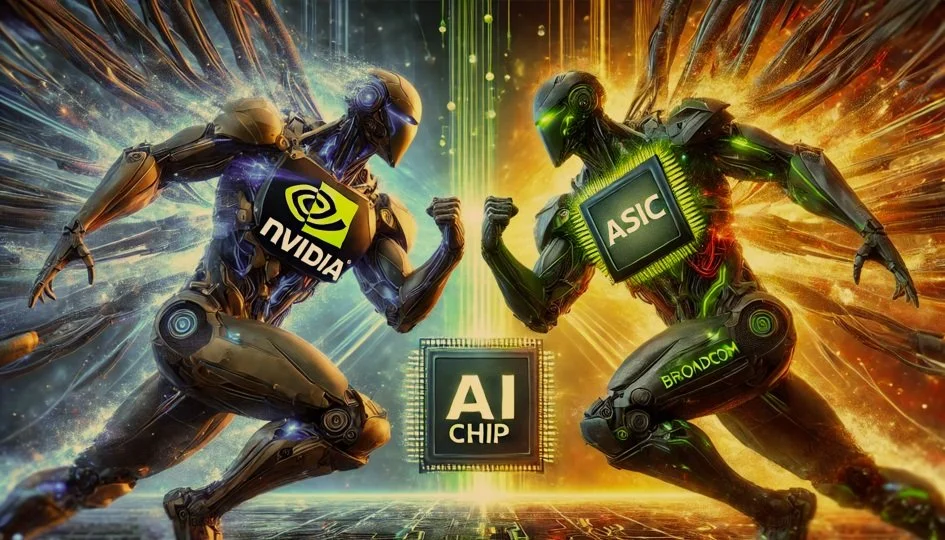
General Purpose GPUs vs. ASICs
| Category | General Purpose GPUs | ASICs |
|---|---|---|
| Applicability and Flexibility | Versatile and adaptable. GPUs excel in training and inference tasks across diverse AI workloads. They are highly adaptable and supported by frameworks like CUDA and TensorFlow, making them ideal for rapidly evolving AI applications. | Narrow focus. Optimized for repetitive inference tasks but lack flexibility for dynamic workloads, limiting adaptability to evolving AI demands. |
| Power Consumption | Energy-intensive, but improving. GPUs are energy-intensive, especially during AI training. For instance, NVIDIA’s A100 consumes up to 400 watts, and large-scale training using 1,000 GPUs can demand 400 kW/hour. However, advancements like NVIDIA’s H100 aim to improve performance per watt. | Highly efficient. Designed for specific tasks, ASICs like Google’s TPUs consume 150W to 600W and achieve up to 7.84 tokens per joule during inference, excelling in large-scale deployments. |
| Training Performance | Unmatched in training. GPUs dominate in training complex models like GPT-3 and GPT-4, thanks to their programmability and ability to handle massive parallel processing. NVIDIA’s GPUs are industry leaders in this domain, offering unmatched performance for cutting-edge research and development. | Limited scope. ASICs struggle with diverse training tasks due to their task-specific nature and lack of ecosystem support, limiting their role in advanced model training. |
| Inference Performance | Flexible for dynamic tasks. GPUs offer exceptional versatility in inference tasks, making them a strong choice for real-time applications like speech recognition or natural language processing in cloud environments. They thrive in dynamic and diverse AI applications. | Optimized for scale. ASICs shine in stable, repetitive inference workloads, like Google’s TPUs handling billions of search queries efficiently. |
| Price | Costly, but broad utility. GPUs like NVIDIA’s A100 cost between $30,000 and $70,000 per unit. Ongoing costs include energy usage, cooling, and software licensing, but their adaptability across tasks often justifies the expense. | High upfront, efficient in scale. ASICs require $20–$100 million in development costs but offer lower per-unit costs when deployed in high volumes, making them suitable for hyperscalers prioritizing cost efficiency in repetitive tasks. |
| Time to Develop and Deploy | Ready out of the box. GPUs are ready for immediate deployment, supported by mature software ecosystems that streamline integration. For example, tools like CUDA ensure rapid usability across various AI tasks. | Slow to market. ASICs require 2-3 years to develop, including custom software ecosystems, delaying deployment compared to GPUs. |
| Software Ecosystem Support | Built for developers. GPUs benefit from a robust ecosystem, including CUDA, cuDNN, and TensorRT, making integration into workflows seamless and accessible for developers across industries. | Limited ecosystem. Lack of out-of-the-box support adds complexity, though exceptions like Google’s TPU ecosystem exist for specific use cases. |
| Access to Semiconductor Tech | Priority access to innovation. GPUs maintain priority access to cutting-edge semiconductor technologies through partnerships with leaders like TSMC. For instance, NVIDIA GPUs leverage advanced nodes such as 5nm and 3nm processes, ensuring ongoing innovation. | Lower priority. ASICs face challenges accessing advanced nodes due to smaller production volumes, as foundries prioritize high-volume customers like GPU manufacturers. |
| Addressable Market | Huge market. The GPU market is projected to grow from $53.71 billion in 2023 to $473.53 billion by 2030, driven by their versatility and adaptability. | Niche growth. ASICs are expected to grow at 85% annually, reaching $30 billion by 2027, but primarily serve hyperscalers and niche applications. |
Summary of General Purpose GPUs vs ASICs
General Purpose GPUs and ASICs represent two contrasting approaches to AI hardware. GPUs are the gold standard for flexibility, excelling in training and inference tasks across diverse and evolving AI workloads. Their programmability and well-supported software ecosystems make them indispensable for innovation-driven applications. However, this versatility comes at a cost, both in terms of energy consumption and initial investment.
In contrast, ASICs excel in efficiency for narrowly defined tasks, such as large-scale inference operations. Their energy savings and lower per-unit costs make them valuable for hyperscalers focused on repetitive workloads. Yet, their high development costs, limited adaptability, and lack of comprehensive software ecosystems constrain their appeal to a niche market. While GPUs dominate the broader AI landscape, ASICs remain effective in specialized roles where efficiency and cost-effectiveness outweigh the need for flexibility.
Conclusion: NVIDIA’s Ecosystem Advantage
NVIDIA’s dominance in AI hardware goes beyond its powerful GPUs. Much like Apple’s success in the smartphone market, NVIDIA’s true strength lies in its ecosystem—a seamless integration of hardware, software, and developer tools. Platforms like CUDA, TensorRT, and other software libraries ensure that NVIDIA’s GPUs are more than just processing units; they are the foundation of a thriving AI development environment.
While ASICs may reduce costs for hyperscalers in specific inference tasks, they cannot match the adaptability and ecosystem support of NVIDIA’s GPUs. The high development costs and rigid nature of ASICs confine them to niche applications, limiting their competitiveness in the broader AI market.
As AI advances toward AGI and potentially Super Intelligence, innovation will demand hardware capable of handling diverse and unpredictable workloads. NVIDIA’s ecosystem-driven approach ensures that its GPUs will remain at the forefront of AI development, while ASICs are likely to remain specialized tools for narrowly defined tasks. In the long run, flexibility, adaptability, and ecosystem integration will define the leaders in AI hardware, with NVIDIA positioned to sustain its dominance.
If you need to better understand the potential role of AI in Business Strategy, Operations or Finance or would like to discuss the benefits of a CFO on Fractional basis contact us
CFO_3.11 To read related articles go to our Blog